
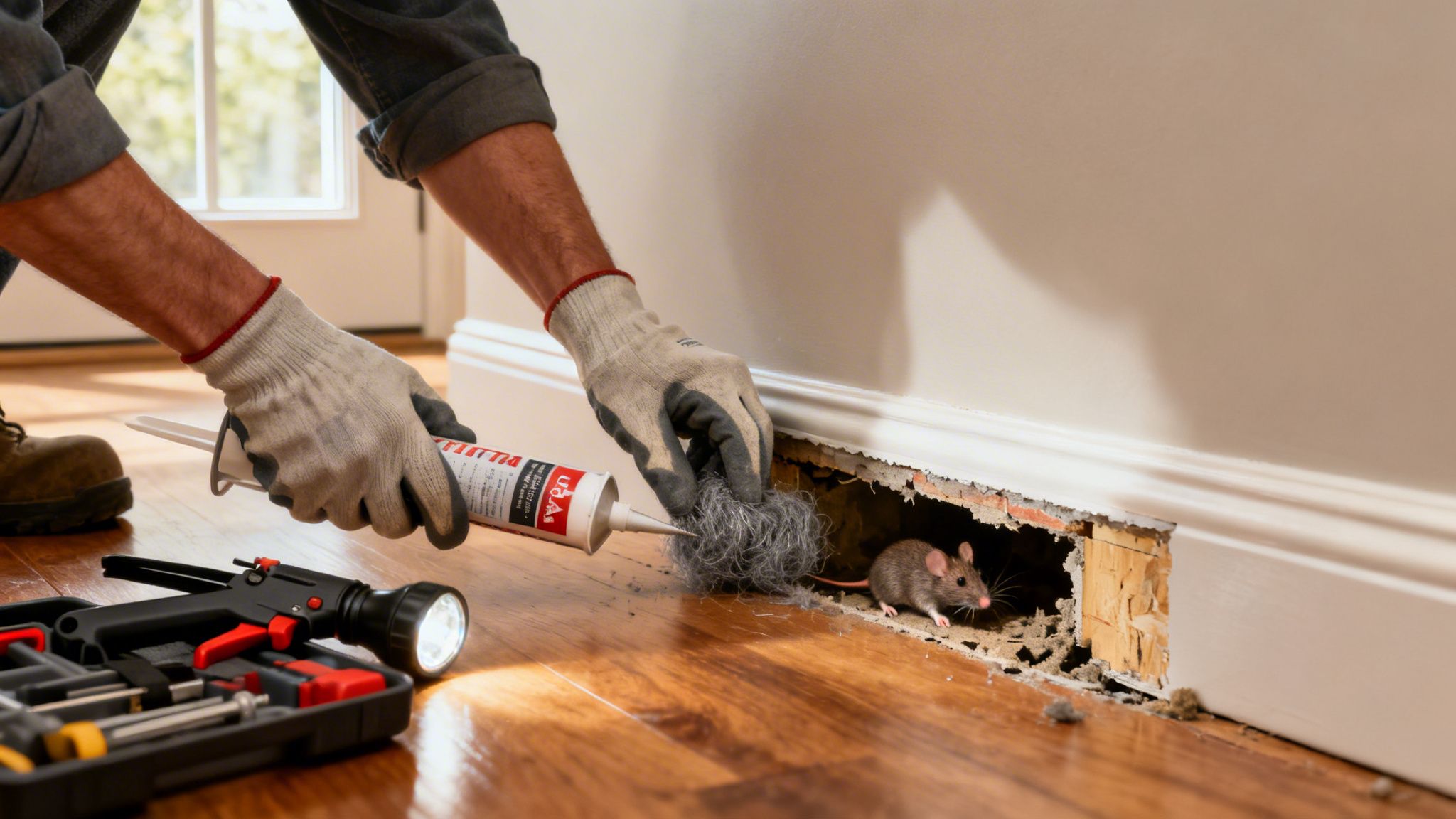

That scratching sound from inside the wall isn't just your house settling. If you're hearing scurrying, scraping, or chewing, chances are you have a rodent in your walls—a problem our pest control technicians see all the time with homeowners across Ontario. These noises, maybe paired with a strange smell or some greasy marks along the baseboards, are the first signs you're not living alone.
It's time to figure out exactly what's going on and why you need to act fast by calling in a professional pest control service.
Decoding the Unsettling Noises in Your Walls

The first thing to do is just listen. Seriously. The sounds you're hearing can tell you a surprising amount about the uninvited guest making a home in your wall voids. Different rodents have very different signatures.
To help you pinpoint the culprit, we've put together a quick reference table based on common calls to our pest control teams.
Common Signs of Rodents in Your Walls
This table breaks down the common clues. Pay attention to not just what you hear, but when you hear it.
| Sign | What to Look For | Most Likely Rodent |
|---|---|---|
| Scratching & Squeaking | Light, fast scratching or high-pitched squeaks, mostly at night. | Mice are small and nocturnal, so their sounds are often faint and quick. |
| Gnawing & Grinding | Slower, heavier chewing or scraping sounds. You might hear this on wood studs, pipes, or wiring. | Rats are much larger and more destructive. Their gnawing is persistent and loud. |
| Scurrying & Scampering | Quick running sounds, often heard along specific pathways in the ceiling or walls. Can be day or night. | Could be mice or rats. If heard during the day, especially in attics, it could be squirrels. |
| Rub Marks | Dark, greasy smudges along baseboards, corners, and around holes in the wall. | Rats and mice both have oily fur and leave these marks along their regular travel routes. |
| Musty Odour | A persistent, stale ammonia-like smell that seems to have no source. | This is the distinct smell of rodent urine and droppings accumulating in an enclosed space. |
Knowing which rodent you're dealing with is half the battle, as it dictates the best way to get them out.
More Than Just Annoying Noises
It's not just the sounds, though. Other subtle signs can confirm a rodent problem is brewing. Look for dark, greasy rub marks along your baseboards. Rodents are creatures of habit and stick to the same "runways," leaving these oily smudges from their fur. A persistent musty odour you can't quite place is another huge red flag, often from urine and droppings building up inside the wall.
For example, a family in a Toronto townhouse recently called our service after ignoring faint scratching for weeks. Their lights started flickering, and our technicians discovered that rats had chewed clean through the insulation on critical electrical wiring. It was a dangerous wake-up call that shows how a "minor" noise signals a major problem best handled by a professional.
A single rodent in the walls is almost never just one. They breed incredibly fast. It’s well-known that just two rats can explode into a population of thousands in a single year under the right conditions, turning a small issue into a full-blown infestation that demands professional help.
Ignoring these early warnings can lead to thousands in property damage and expose your family to health risks. If you're in a community like Milton or Aurora and suspect an issue, getting a professional assessment from a local pest control service is the smartest move. It can stop a small problem from becoming a crisis.
Why Your Walls Are Prime Real Estate for Rodents—And the Dangers Lurking Within
To you, it's just the empty space behind the drywall. To a mouse or rat, it's a five-star hotel. Those hidden cavities between your walls offer everything a rodent could dream of: protection from predators, warmth from your home’s insulation, and a secret network of highways to navigate your house undetected.
It’s the perfect spot for them to build a nest and raise a family. But for you, the homeowner, this rodent paradise is a powder keg of hidden dangers that go far beyond just unsettling scratching sounds. For many of us here in Canada, these pests can seriously threaten our property and our family's safety.
The True Cost of Gnawing Pests
A rodent's teeth grow continuously, which means they have a constant, biological urge to chew on anything and everything. When that chewing happens inside your walls, the consequences can be devastating.
- A Serious Fire Hazard: One of their favourite things to gnaw on is electrical wiring. They strip the plastic coating right off, exposing the live wires. All it takes is one spark to ignite the surrounding wood framing or insulation, and you've got a major fire on your hands.
- Water Damage Nightmares: Many modern homes across Ontario use flexible PEX plumbing lines, which are often run through wall cavities. Rodents can chew through these pipes in no time, causing everything from a slow, hidden leak to a full-blown flood that results in thousands of dollars in water damage.
- Compromised Structures: Their destructive chewing doesn't stop there. They can weaken wooden studs, tear apart insulation for nesting material, and destroy vapour barriers. A damaged vapour barrier is particularly nasty, as it allows moisture to seep into your walls, creating the perfect conditions for mould.
Once moisture gets in, you have a whole new problem. Understanding the signs of mold in walls becomes critical, as rodent activity can often be the root cause.
From a Scratch to a Catastrophe: A Real-World Story
This happens more often than you think. Take the case of a homeowner our team assisted in Niagara Falls. It all started with some faint scratching noises—nothing they were too worried about. But within a few weeks, their lights started flickering.
An electrician they hired traced the issue back to a family of rats that had nested right next to a junction box, chewing several electrical wires completely bare. The homeowner then called our pest control service to handle the infestation and secure the home against future entry. This isn't a rare occurrence.
More and more, especially in urban areas, homeowners are finding these pests have made their way inside the walls. From there, they chew on wiring and insulation, spreading diseases like salmonella and creating huge fire risks. And since two rats can produce up to 15,000 offspring in a single year, a small problem can become a full-blown infestation incredibly fast. It's a scenario that has prompted discussions about the government-created rodent plague on californiaglobe.com.
When rodents get into your walls, it’s no longer just a nuisance—it’s a safety crisis. The hidden damage they cause can threaten your home's structure and create a significant fire risk that needs immediate, professional attention.
This is where a DIY approach often falls short. Finding and removing nests from deep inside a wall void without causing more damage requires specific tools and a lot of experience. For a truly safe and complete solution, your best bet is to call in a professional rodent removal service. Whether you're in Toronto, Aurora, or anywhere in Ontario, an expert can properly assess the damage and make sure your home is secure.
Finding and Sealing Every Entry Point: Your First Move
Before you even think about laying a single trap, there’s a more critical job to do: cutting off the source. If you don't seal up every last entry point, you’re just inviting a new wave of rodents in as soon as you get rid of the current ones. It's a frustrating cycle our technicians see constantly. Long-term success comes down to a thorough inspection of your home’s exterior to block every possible gap, a service known as exclusion.
It’s hard to believe, but a mouse can flatten its body and squeeze through a hole the size of a dime. A rat only needs a gap the size of a toonie. In many Canadian homes, especially in areas like Milton or Aurora, small gaps are often left during construction around utility lines or at the corners of siding. If you find yourself dealing with mice every winter, you can bet there’s a tiny, overlooked entry point somewhere.
The Exterior Inspection Walk-Around
A professional pest control technician will perform a methodical perimeter check, but you can get a head start by looking for these common weak spots:
- Foundation and Siding: Scan for cracks in the foundation, no matter how small. Pay close attention to where the siding meets the foundation—this is a classic weak point.
- Weep Holes: Those small drainage gaps in brick exteriors are basically open doors for mice.
- Utility Entries: This is a big one. Inspect every pipe, wire, and vent entering your home. Gaps around gas lines, air conditioning units, and outdoor taps are prime real estate for rodents.
- Vents and Soffits: Check all your roof vents, dryer vents, and soffits for damage or missing screens.
Sealing these entry points isn't just about convenience; it's about safety. Once rodents are inside your walls, the stakes get much higher.

As you can see, the damage goes far beyond just annoying noises. From frayed wires creating a serious fire hazard to the spread of disease, a small entry point can lead to major consequences.
Sealing Gaps the Right Way
Once gaps are found, they need to be plugged with materials that rodents can’t simply chew through. Standard spray foam or caulk alone is a temporary fix at best. Mice and rats will make short work of it.
A Real-World Example from Brampton: Our pest control team worked with a homeowner who was at their wits' end, dealing with mice every single winter despite setting dozens of traps. We tracked the source to a tiny half-inch gap around a utility pipe, completely hidden by a bush. By packing it with steel wool and a proper sealant, we permanently solved a problem that had plagued them for years.
For a seal that actually lasts, professionals layer materials:
- Steel Wool or Copper Mesh: First, stuff this into the gap. Rodents hate the feeling of chewing on metal, and it will stop them in their tracks.
- Heavy-Duty Sealant: After packing the mesh, a high-quality, pest-resistant sealant is applied over top to create an airtight and solid barrier.
- Hardware Cloth: For larger openings like unscreened vents, this sturdy metal mesh is used to create a permanent, chew-proof cover.
For certain areas, you might even consider researching materials like rodent-proof spray foam insulation, which offers both insulation and pest-blocking properties.
Let's be honest, though. Finding every single crack, especially in older homes in cities like Niagara Falls or Toronto, can be a massive undertaking. If the problem feels overwhelming or keeps coming back, calling in an expert for professional wildlife removal and exclusion is your best bet for a guaranteed solution.
Effective DIY Trapping for Rodents in Your Walls

So, you’ve sealed up every crack and crevice on the outside of your home. That’s a great first step, but now you have a new problem: the rodents that are already inside are now trapped in with you. Getting them out requires a bit of strategy.
You can’t put traps inside the actual wall, so the trick is to target their routes. Rodents are creatures of habit and prefer to scurry along the edges of rooms for safety. Think of your baseboards as their personal highways. Place your traps right up against the wall in any areas where you've heard scratching or found droppings. This forces them to cross directly over the trap on their nightly travels.
Choosing and Baiting Your Traps
Walk into any hardware store and you'll see a dozen different types of traps. What you choose really depends on the scale of your problem and your personal comfort level with the outcome.
Here’s a quick rundown of the most common options:
- Snap Traps: The old-school classic for a reason. They’re cheap, reusable, and deliver a quick kill when set properly. The key to success is using a lot of them—don't just set one and hope for the best. Place them every few feet along their suspected path.
- Electronic Traps: A more modern, hands-off approach. These use bait to lure the rodent into a chamber where it receives a fatal electric shock. They cost more, but they’re self-contained and make disposal clean and simple.
- Live Traps: If the thought of killing the animals is a non-starter for you, live traps are an option. Just know that you're responsible for what comes next. You'll need to drive the rodent miles away from your home to release it (be sure to check your local by-laws first), and they aren't always practical for a large infestation.
When it comes to bait, forget what you’ve seen in cartoons. Cheese dries out and is easy for a clever mouse to swipe. You need something sticky and irresistible. Use a dab of peanut butter mixed with a few oats or bird seeds. It makes the bait more fragrant and forces the rodent to work at it, which is exactly what you want.
The Unfortunate Reality: A Rodent Dies in the Wall
This is the big risk with any DIY approach, but it's almost guaranteed if you use poison baits (which pest control professionals strongly advise against for this very reason). When a rodent dies in a wall, the resulting odour is unmistakable and truly awful. It can permeate your home for weeks, and finding the source often involves a grim game of "follow your nose."
Cutting into your drywall to retrieve a dead animal is a clear sign you’re in over your head. It’s a messy, difficult job that can cause a lot of damage if you don’t know exactly where to cut. This is the moment to put down the tools and pick up the phone.
This exact situation plays out in homes all across Ontario, from Aurora to Niagara Falls. If you're faced with that smell, it's time to call in a professional. A rodent removal expert has specialized tools, like moisture meters and borescopes, to pinpoint the location and remove the source with minimal damage to your home. For a more comprehensive approach, you might look into full pest control services in Toronto to make sure your home is secure from top to bottom.
Knowing When to Call a Professional Pest Control Service
Look, trying to tackle a rodent issue on your own is admirable, but sometimes you’re just fighting a losing battle. Having a rodent in walls is a whole different ball game, and knowing when to hand the problem over to a pro is key to protecting your home and your sanity.
If you’ve been diligently setting traps for a few weeks and are still hearing those tell-tale scratching sounds or finding fresh droppings, that’s your first major clue. It usually means the infestation is bigger than you thought, or the critters have found entry points you haven't.
Red Flags That Mean It's Time for a Pro
Some signs are more than just clues—they’re giant, waving red flags telling you the problem has outgrown a DIY fix. If you spot any of these, it's time to pick up the phone and call a pest control service.
- That Unmistakable, Lingering Smell: A faint, musty scent is one thing. But a powerful, sharp ammonia-like odour that won't go away is a sure sign of a large, active nest. That smell is from a significant amount of urine soaking into your insulation and wall materials.
- Seeing Rodents During the Day: Rodents are naturally shy and stick to the shadows, mostly at night. If you start seeing them scurrying around in broad daylight, it often means the nest is so overcrowded that weaker members are being forced out to find food.
- They Keep Coming Back: You’ve sealed every crack and hole you could find, yet the activity returns. This is a classic sign that they’re using hidden routes you can’t easily see, like entry points under siding, along the roofline, or even through the sewer system.
When you see signs like these, you're past the point where a few traps will solve anything. The infestation is well-established and needs a more strategic approach from a pest control professional.
The Professional Advantage: Technology and Expertise
Professional pest control technicians bring more than just traps to the table. They show up with advanced gear and, more importantly, a deep understanding of rodent behaviour. For a tricky rodent in walls problem, they might pull out a thermal imaging camera to spot the heat signature of a nest or use a tiny endoscopic camera (a borescope) to see exactly what’s happening inside your walls with minimal damage.
This kind of tech allows them to pinpoint nests and find deceased rodents without turning your drywall into swiss cheese.
A business owner in Ottawa learned this lesson the hard way. He spent months trying to manage a rat problem in his shop, only to have it spread through the shared walls into neighbouring units. He ended up needing a full commercial pest control plan to fix a situation that would have been far quicker and cheaper to resolve if he’d called a professional from the start.
For homeowners and business owners across Ontario, from Niagara Falls to the GTA, the smartest move is to connect with a licensed and vetted company. A pro service doesn't just get rid of the rodents; they also guarantee their exclusion work to make sure they don't come back. If you're dealing with a stubborn problem, getting help from expert pest control services in Toronto provides a definitive solution and safeguards your property for the long haul.
Common Questions About Rodents in Walls
Hearing that telltale scratching from inside a wall is enough to make any homeowner's skin crawl. If you're in that boat, you probably have a ton of questions. Here are some of the most common ones our pest control experts get from homeowners across Ontario.
Can Rodents in Walls Go Away on Their Own?
We wish we could say yes, but it’s incredibly rare for rodents to just pack up and leave. Think about it from their perspective: the space between your studs is warm, dry, and completely safe from predators. It's the perfect superhighway for them to travel through your house to find crumbs in the kitchen or a leaky pipe in the basement.
This setup is just too good for them to abandon. A homeowner in Milton, for example, might hear a mouse in the fall and hope it leaves once the weather warms up. In reality, that mouse has likely already started a family. Without professional intervention, that small problem is almost guaranteed to grow into a full-blown infestation requiring comprehensive rodent removal.
Is It Safe to Use Poison for Rodents Inside Walls?
This is a big one, and a strategy we strongly advise against for any DIY attempt. The number one mistake people make is tossing poison bait into the wall void. The rodent eats it, gets sick, and crawls somewhere deep and inaccessible to die.
What happens next is awful. A truly nauseating odour starts to permeate your home, and it can last for weeks. The only way to get rid of it is to find and remove the carcass, which usually means cutting open your drywall. Professionals in areas like Aurora have strategic methods designed to prevent this exact nightmare, guiding the rodent out of the wall before it perishes and solving the problem without the secondary consequences.
A crucial point to remember is that a standard Canadian home insurance policy does not cover damage caused by pests like rodents. Infestations are generally considered a maintenance issue. This makes it vital to handle the problem correctly the first time to avoid paying out-of-pocket for expensive repairs to chewed wires or ruined insulation.
How Much Does Professional Rodent Removal Cost in Ontario?
The cost of calling in a pro really depends on a few key things: the size of your home, the severity of the infestation, what kind of rodent you're dealing with, and how much work is needed to seal up all the entry points for good.
A straightforward job might only run you a few hundred dollars. However, for a complex infestation in a large house with multiple entry points, the cost could easily climb over a thousand. This is often the case with persistent issues or other complex infestations, such as bed bug removal, where comprehensive treatment is necessary.
To get a better handle on the specifics, our guide to professional rodent removal services is a great resource. Your best bet is always to get quotes from a few reputable local companies. That way, you can compare their plans and find a price that works for your situation.
No matter where you are in Ontario, from Niagara Falls to Toronto, ServiceQuotes.ca can help. We connect you with vetted, local pest control experts who know how to handle these problems. Just submit a quick request, and you’ll get up to three free, no-obligation quotes from trusted professionals in your area.