
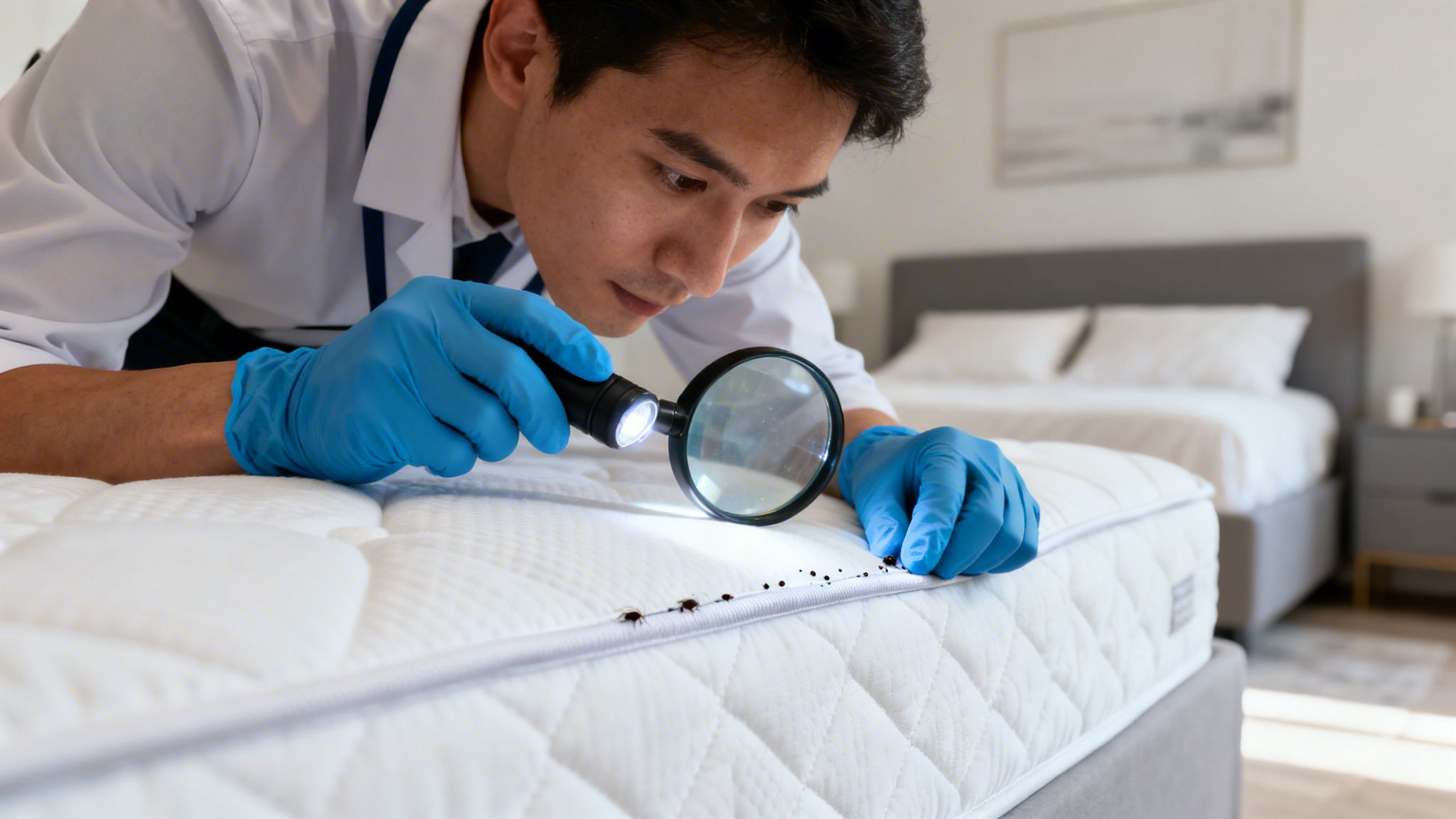

Think you might have bed bugs? The first step—before you panic or start throwing things out—is to get a professional bed bug inspection. This is more than just a quick look-around; it's a detailed investigation by a trained pest control technician to find hard evidence of an infestation. They’re looking for live bugs, sure, but also the subtle clues they leave behind. This is a crucial step because these pests are experts at hiding, making them incredibly difficult to spot on your own. A proper inspection by a local Ontario pest control service is the foundation for effective bed bug removal.
Decoding the First Signs of Bed Bugs

Most bed bug stories start small. It might be an itchy red welt on your arm you blame on a mosquito, or a tiny dark smudge on your sheets you wipe away without a second thought. Dismissing these early signs is a huge mistake. A few bugs can quickly multiply into a widespread infestation that requires extensive and costly bed bug removal.
Early Warning Signs You Cannot Ignore
We see it happen all the time in our pest control work across Ontario. A family in Milton thought their child’s red bumps were just a mild skin rash. It wasn't until weeks later, when they saw a live bug crawling on a pillow, that they called for help. By that point, the bugs had already migrated from the bedroom to the living room couch, turning a small issue into a major one requiring a comprehensive treatment plan.
In another case, a condo owner in downtown Toronto kept finding what looked like tiny apple seeds near his headboard. He’d just brush them away, not knowing they were the shed skins of growing bed bug nymphs. Catching these signs early and calling for a professional bed bug inspection is your best line of defence.
Knowing how to tell if you have bed bugs is all about recognizing the evidence. To help you identify what you might be seeing, here’s a quick guide to the most common signs.
Quick Guide to Bed Bug Evidence
This chart breaks down the key pieces of evidence bed bugs leave behind, what they look like, and the most common places you'll find them.
| Evidence | What It Looks Like | Where to Find It |
|---|---|---|
| Fecal Spots | Small, dark brown or black specks, like an ink pen dot that has bled into fabric. | Mattress seams, box springs, sheets, headboards, and along baseboards. |
| Shed Skins (Exoskeletons) | Translucent, yellowish-brown casings shaped like a bed bug. | Crevices of mattresses, behind headboards, in furniture joints, and along walls. |
| Tiny Eggs & Eggshells | Pearl-white, oval, and only about 1 mm long. Often found in tiny clusters. | Tucked into fabric seams, cracks in wood, and other tight, protected spaces. |
| Live Bugs | Adult bugs are flat, oval, reddish-brown, and about the size of an apple seed. | Any of the above hiding spots, especially active at night. |
Use this as a reference when you're doing a preliminary check of your sleeping areas and furniture. Finding just one of these signs is enough reason to call a pest control service for a professional opinion.
The Distinctive Scent of an Infestation
If an infestation has grown large, your nose might be the first to know. People often describe a distinct odour that's musty and slightly sweet—some compare it to coriander or overripe raspberries. This smell comes from the alarm pheromones the bugs release when disturbed. If you catch a whiff of this strange aroma in your bedroom, it's a strong sign you need an inspection right away.
A professional pest control technician isn't just looking for bugs; they're piecing together a puzzle. The location of fecal stains, the number of shed skins, and the presence of eggs all tell a story about the size and age of the infestation, guiding the entire treatment strategy.
If you’ve spotted any of these clues, don't wait and hope it goes away. The sooner you act, the simpler the solution will be. A professional inspection is the only way to know for sure what you're up against and develop a solid plan to get your home back. Whether you need expert bed bug removal or help with other pests in cities like Aurora or Niagara Falls, your next step should be connecting with a local pro through our pest control services page.
What to Expect During a Professional Inspection
Let’s be honest, the idea of having a stranger go through your personal space can feel invasive. But when it comes to bed bugs, a professional inspection isn't about judging your housekeeping—it's about gathering clues. Think of your technician as a detective from a trusted Ontario pest control company, methodically hunting for evidence to solve the case.
This initial search is the single most important step in getting rid of bed bugs for good. Any treatment plan is just guesswork without a clear map of where the pests are hiding. A missed hiding spot means the infestation will almost certainly bounce back.
The Initial Consultation
The inspection starts the second your technician walks through the door, but not with a flashlight. It starts with a conversation. Let's say our technician is at a family home in Aurora. The first thing they'll do is ask some pointed questions to build a profile of the problem:
- Who is getting bites, and where on their body? This helps zero in on which beds or couches are the likely epicentres.
- When did the bites start? This gives them a rough timeline for how established the infestation might be.
- Have you travelled recently? Bed bugs are expert hitchhikers, so a recent trip could be the origin story.
- Have you brought any second-hand furniture into the home? Another classic entry point for these unwanted guests.
This chat isn't just small talk; it's a critical first step. The answers help the technician focus their search on the most probable hotspots, making the whole process more efficient and accurate. This is standard procedure for any reputable pest control service, whether it's a single-family home or a larger commercial pest control situation.
The Systematic Search for Evidence
After the initial chat, the real hunt begins. The technician will pull out their tools—usually a high-powered flashlight and a magnifying glass—and start a systematic search of the room. They move with a purpose, checking all the dark, tight spaces that bed bugs love to call home.
Back in our Aurora home, the pro starts in the master bedroom, where the bites were reported. Their search is incredibly thorough.
- The Bed: This is ground zero. They'll meticulously inspect the mattress, box spring, bed frame, and headboard, paying close attention to every single seam, tuft, and screw hole.
- Furniture Near the Bed: Nightstands, dressers, and armchairs are next. They'll empty drawers and check the joints, undersides, and backs of all nearby furniture.
- Room Perimeters: The search then expands outward to baseboards, the edges of the carpet, and the frames around windows and doors.
- Hidden Spots: A true professional knows all the unlikely hiding spots. They'll check behind picture frames, inside electrical outlets, and even in the spines of hardcover books next to the bed.
A pro's search isn't random; it's based on science. They know that bed bugs typically hide within a 5- to 15-foot radius of their food source (you!). This knowledge allows them to conduct a targeted and highly effective search instead of just looking around aimlessly.
While you often hear about massive infestations in large US cities, the problem is just as prevalent in Canadian urban centres. For example, a student moving into a downtown Toronto apartment complex could unknowingly bring bed bugs that quickly spread to adjacent units, a scenario pest control services see frequently.
Ultimately, a professional inspection gives you a definitive "yes" or "no." It confirms the presence of bed bugs, determines the scale of the problem, and identifies every last hiding spot. This roadmap is absolutely essential for creating a treatment plan that actually works, making it the most critical investment in taking back your home. For more on tackling different pest issues, our comprehensive guide to pest control services is a great resource.
How Professionals Find Hidden Bed Bugs
When you call in a professional pest control service, you're getting more than just a person with a flashlight. A true expert comes equipped with years of experience and a whole range of tools to track down bed bugs, whether it’s a full-blown infestation or just a few early invaders. Knowing what they do and why they do it can give you a lot of peace of mind.
Every professional inspection follows a clear, methodical path. It’s not a random search; it’s a systematic process to make sure nothing gets overlooked.

It always starts with a conversation to understand what you've been seeing, moves into a detailed investigation, and ends with a solid confirmation so you know exactly what you’re dealing with before any bed bug removal is recommended.
The Standard Visual Inspection
The foundation of any good inspection is a hands-on visual search. This isn't just a quick look around; it's an incredibly detailed process where a technician's trained eye knows exactly where to look for the subtle signs of bed bugs.
Think about a technician from a local Ontario pest control company walking into a bedroom in Aurora. They aren't just glancing at the mattress. They're taking the bed apart piece by piece, checking every seam, tuft, and tiny crevice in the mattress and box spring. They’ll get into the bed frame, look behind the headboard, and even pop off electrical outlet covers to check inside the walls. It’s this meticulous approach that makes all the difference, because even a single missed bug can start the problem all over again.
Canine Bed Bug Inspections
For an even higher degree of certainty, many pros now bring in a secret weapon: a bed bug-sniffing dog. These specially trained dogs use their incredible sense of smell to sniff out the unique pheromones given off by live bed bugs and their viable eggs. It's faster and often more accurate than the human eye alone.
A well-trained bed bug detection dog can have an accuracy rate of over 95%. They are an amazing tool for getting fast confirmation in a large space or for verifying that a treatment was successful.
This is a go-to option for commercial pest control clients. For instance, a hotel owner in Niagara Falls can use a canine team to discreetly check multiple rooms in a single morning, pinpointing the exact source of a problem without alarming guests. This same high-tech service is available to homeowners in cities like Toronto who need definitive answers, fast.
Interceptor Traps and Monitors
What happens when the signs are faint or you suspect an infestation is just beginning? In cases where there's no "smoking gun," a technician may install interceptor traps or passive monitors. These are simple but clever devices placed under the legs of your bed and other furniture.
- How They Work: As you sleep, you exhale carbon dioxide, which attracts bed bugs. When they try to climb up the furniture legs for a meal, they fall into the trap's slick-walled pit and can't get out.
- Purpose: These traps act as a 24/7 monitoring system. Catching even a few bugs over several days provides concrete proof of an active infestation, even when a visual inspection comes up empty.
A perfect example is a tenant in a Milton apartment who was getting bites but couldn't find any bugs. A pest pro placed interceptors under their bed, and within a week, they had captured several nymphs. This gave them the solid evidence needed to move forward with a targeted bed bug removal plan. It's a smart way to confirm a problem before committing to treatment. Finding a local pro who uses these kinds of diagnostic tools is easy using our general pest control page.
How to Do a Preliminary Bed Bug Check Yourself

So, you think you might have bed bugs. Before you jump to conclusions or call in the pros, doing a little detective work on your own can be incredibly helpful. Think of this as gathering intel. The evidence you find will give a pest control expert a much clearer picture of what you're dealing with when you do make that call.
Just remember, a DIY check is a starting point, not a substitute for a professional inspection. Bed bugs are masters of concealment, and an untrained eye can easily overlook the subtle signs of a new infestation. Your mission isn't to find every last bug—it's to confirm whether there's enough reason to bring in an expert from a qualified pest control service.
Your DIY Inspection Toolkit
You don’t need a lot of fancy gear for a basic sweep. In fact, you probably have everything you need lying around the house.
- A Bright Flashlight: Your phone’s light will do in a pinch, but a dedicated, high-powered flashlight is far better for peering into those dark cracks and corners.
- A Magnifying Glass: This is crucial. It helps you get a good, close look at any tiny specks you find to see if they're eggs, shed skins, or the tell-tale fecal stains.
- A Stiff, Thin Card: An old credit card, a used-up gift card, or even a playing card works perfectly. You’ll use it to scrape along seams and joints to see if you can fish out any hidden evidence.
With these simple tools in hand, you’re ready to start the hunt. The key here is to be patient and methodical. Slow and steady is the way to go.
A Step-by-Step Plan for Your Search
Always start your search in the room where you suspect the most activity—which, nine times out of ten, is the bedroom. A pro would work their way from the bed outwards, and you should too.
- Inspect the Mattress and Box Spring: First, strip all the bedding off and check it carefully for any stains or live bugs. Next, grab your flashlight and credit card. Go over every single seam, tuft, and tag on your mattress. Scrape the card along the seams to see what comes out. Flip the mattress and do it all again, then repeat the entire process with the box spring.
- Examine the Bed Frame and Headboard: These are prime real estate for bed bugs. Check every joint, screw hole, and crevice in the bed frame. If your headboard is mounted on the wall, you absolutely have to check the space behind it.
- Check Nearby Furniture: Bed bugs don't just stay in bed. They travel. Empty out any nightstands and dressers close to the bed. Check inside and under the drawers, along the joints, and on the undersides of the furniture itself.
- Widen the Search: If you've found some signs of activity, it's time to expand your search radius. Look along the baseboards, behind picture frames, and around electrical outlets and light switches.
A common mistake is just glancing at the surface of the mattress. Bed bugs spend the vast majority of their time crammed into tight, dark spaces. A proper DIY inspection means looking in and around the bed, not just on it.
This process gives you a real-world glimpse into a problem plaguing major cities. Densely populated areas are bed bug hotspots, a pattern we see across North America. While much of the available data comes from the US, this trend certainly holds true for Ontario's bustling urban centres. You can find reports online that dive deeper into why urban environments are so susceptible to these pests, such as this article about how bed bug issues can surge in communities on preferredpestcontroloc.com.
Even after a thorough search, it’s incredibly easy to miss something. Bed bug nymphs are almost translucent, and their eggs are no bigger than a pinhead. That’s why a DIY check is best treated as a fact-finding mission. If you find anything that looks suspicious, your very next step should be to get a definitive bed bug inspection from a verified professional. Experts specializing in pest control in Toronto or Milton have seen it all and can confirm what you've found, then lay out a clear plan of action.
Choosing a Qualified Bed Bug Inspector in Ontario
When you're dealing with something as stressful as bed bugs, the expert you hire makes all the difference. The success of the treatment, the final cost, and your peace of mind all come down to how good that first inspection is.
This is definitely not the time to look for a quick deal on a classifieds site. A botched inspection or a weak treatment plan from an unqualified provider will just drag out the misery. You'll end up spending more in the long run when the infestation inevitably bounces back.
Must-Have Qualifications for Ontario Pest Control
Pest control is a regulated industry in Ontario for a good reason. Technicians work with potent products and need specialized knowledge to do their job safely and effectively. Before you hire any pest control service, make sure they check these non-negotiable boxes.
- Proper Licensing: The company and its technicians absolutely must be licensed by the Ontario Ministry of the Environment, Conservation and Parks. This is your proof that they're trained and legally allowed to apply pest control products in your home.
- Comprehensive Insurance: Always ask to see proof of liability insurance. It’s a safety net that protects you and your property in the rare case that something goes wrong during the inspection or treatment.
- Specific Bed Bug Experience: Don't just hire a generalist. You need a company that has a deep, proven track record specifically in bed bug removal. You're paying for their specialized expertise on how these pests think, hide, and breed.
Think of it this way: you wouldn't ask your family doctor to perform open-heart surgery. Both are medical professionals, but you need the specialist. The same rule applies here when choosing a pest control service.
Essential Questions to Ask Before You Hire
Once you have a short list of licensed and insured companies, it's time to do some digging. Any truly professional company will have no problem answering your questions. How they respond will tell you everything you need to know about their approach.
One of the biggest red flags is a company that gives you a firm price over the phone without ever seeing your space. A real pro knows a thorough bed bug inspection is the only way to understand the scope of the issue and provide an accurate quote for treatment.
Here are the critical questions you should be asking potential pest control providers:
- What inspection methods do you use? Do they rely on a visual search, bring in a canine team, or use monitors? A pest control service with multiple tools in its arsenal is usually better equipped for a thorough job.
- What is your success rate with bed bugs? Ask them what their follow-up process looks like and how they confirm the problem is actually solved for good.
- Do you offer a service guarantee? Solid companies often stand behind their work with a guarantee, which might include free follow-up visits if bugs show up again within a specific period.
- Can you provide a detailed report of your findings? You should expect a professional report that maps out where they found evidence, rates the severity, and lays out a clear, recommended action plan.
The right approach can vary. For example, tackling an infestation in a detached home in Aurora is a different ball game than dealing with one in a high-rise apartment building. A qualified inspector will know how to adapt. If you want to see what top-tier service looks like in a dense urban setting, learning more about professional pest control in Toronto can be a good benchmark. Finding that trustworthy local expert is the first—and most important—step you'll take.
Preparing For and Following Up After an Inspection
Think of a professional bed bug inspection as a team effort. Your cooperation before and after the technician’s visit can make all the difference between a quick, accurate diagnosis and a much longer, more frustrating ordeal. By taking a few key steps, you’re not just clearing a path—you're helping the pest control expert solve the mystery.
Proper prep ensures they can access every potential hiding spot without accidentally scattering the pests and making the problem worse.
Before the Technician Arrives
A little bit of prep work goes a long way in helping your pest control expert succeed. The goal here isn't to deep clean the house, but to provide clear, easy access to the areas they need to check.
- Reduce Clutter: Clear away any clothes, boxes, or other items from the floor, especially in bedrooms and around upholstered furniture. This gives the inspector room to move and eliminates common hiding places.
- Provide Access: Your inspector needs to see all sides of your beds, couches, and dressers. If furniture is pushed up against a wall, try to pull it out by a foot or two so they can get a good look behind it.
- Strip Beds (But Don't Move Linens): Take all the sheets, blankets, and pillowcases off your beds. This part is critical: leave them in a pile in the centre of the room. Moving potentially infested bedding to another area is one of the fastest ways to start a new infestation elsewhere in your home.
The most common mistake people make is bagging up all their bedding and hauling it to the laundry room right before an inspection. A trained pro will want to examine those sheets for fecal spots and other signs. It’s like throwing away clues at a crime scene—those linens tell a story about the infestation.
After the Inspection: What Comes Next?
Once the search is over, your technician will sit down with you to go over their findings. This is the moment of truth that decides what happens next.
If Bed Bugs Are Confirmed
If the inspector has found clear evidence of bed bugs, they will lay out a professional treatment plan. This strategy will be based on how widespread the infestation is and the specifics of your home. They’ll explain the options, which usually involve either professional heat treatments or precisely applied chemical solutions, and give you a detailed prep sheet for the chosen method. This is where the real work begins, and following a professional plan is your surest path to successful bed bug removal.
If No Bed Bugs Are Found
Getting the all-clear is a massive relief! Even so, it’s smart to stay on guard. Your technician might recommend a few preventative steps to keep your home protected. A great first step is to install high-quality mattress and box spring encasements. These zippered covers trap any stragglers that might have been missed and stop new bugs from setting up camp in your bed.
This kind of proactive thinking is key, as bed bug problems can flare up when you least expect them. For instance, a real-life example from a pest control service in Toronto involved a client who got a clear inspection, only to have a new infestation start a month later from a neighbouring apartment unit. This shows how quickly a small issue can become a community-wide headache. You can discover more insights about how bed bug issues can surge in communities on preferredpestcontroloc.com. By taking these simple follow-up steps, you become an informed partner in getting—and keeping—your home bed-bug-free.
Frequently Asked Bed Bug Inspection Questions
If you’re worried you might have bed bugs, you’ve probably got a lot of questions running through your mind. It's completely normal. Getting clear, straightforward answers from a local Ontario pest control service is the first step to getting peace of mind. Here’s a look at what residents most often ask about professional bed bug inspections.
How Much Does a Bed Bug Inspection Cost in Ontario?
Let's talk numbers. For a standard visual inspection in a typical apartment or smaller home, a pest control service will generally charge anywhere from $75 to $200. The technician will manually check all the common hiding spots.
Thinking of bringing in the big guns with a canine inspection? With a highly trained dog doing the sniffing, the cost usually starts around $250 and can go up to $400 or more. The final price really hinges on your home's size and where you're located—costs in a major hub like Toronto might be different than in a smaller city like Milton. On the bright side, many reputable pest control companies will often credit the inspection fee toward your treatment costs if they find an active infestation.
Is the Landlord or Tenant Responsible for Inspections in Ontario?
This is a big one for renters, and thankfully, the law in Ontario is quite clear. The landlord is responsible for keeping the property in a good state of repair and fit to live in, and that includes dealing with pests.
Under the Residential Tenancies Act, the responsibility and cost for a bed bug inspection—and any needed treatment—almost always fall on the landlord. That said, as a tenant, you have a critical role to play. You must tell your landlord about a suspected problem right away and cooperate with the entire process. If a pest control pro needs to get into your unit in Aurora to check things out, for instance, you have to provide access.
How Long Does a Professional Inspection Take?
The time it takes really depends on the size of your place and how much stuff you have. A thorough visual inspection of a standard one-bedroom apartment might take anywhere from 30 to 60 minutes.
For a larger, multi-storey house, an inspector could easily need two hours or more to do a truly meticulous job. They have to check everywhere—not just the bed, but all the furniture, along the baseboards, and even behind light switches. A canine inspection can cover ground faster, but the handler still needs to visually confirm any spot the dog flags. Rushing an inspection is a huge mistake; it just increases the odds of missing a few bugs, which can lead to a failed treatment and the whole nightmare starting over again.
When you need a definitive answer and a fast, reliable solution, it’s time to call in the experts. ServiceQuotes.ca connects you with vetted, local pest control professionals across Ontario for services like bed bug removal and other pest challenges. You can get up to three free, no-obligation quotes to find the right pro for the job, quickly and confidently.